A little bit about our story
Top Tier Farms started with a simple opportunity and a kid who couldn’t let it go. In April of 2012, I brought home my first chicken coop after a neighbor offered me one he no longer wanted. A few weeks later, I picked up my first two hens at First Monday Trade Days in McKinney, Texas—a red sex link and a black sex link. They weren’t show birds, but they were my first chickens, and they lit the spark that turned into nearly 14 years of breeding and exhibiting poultry.
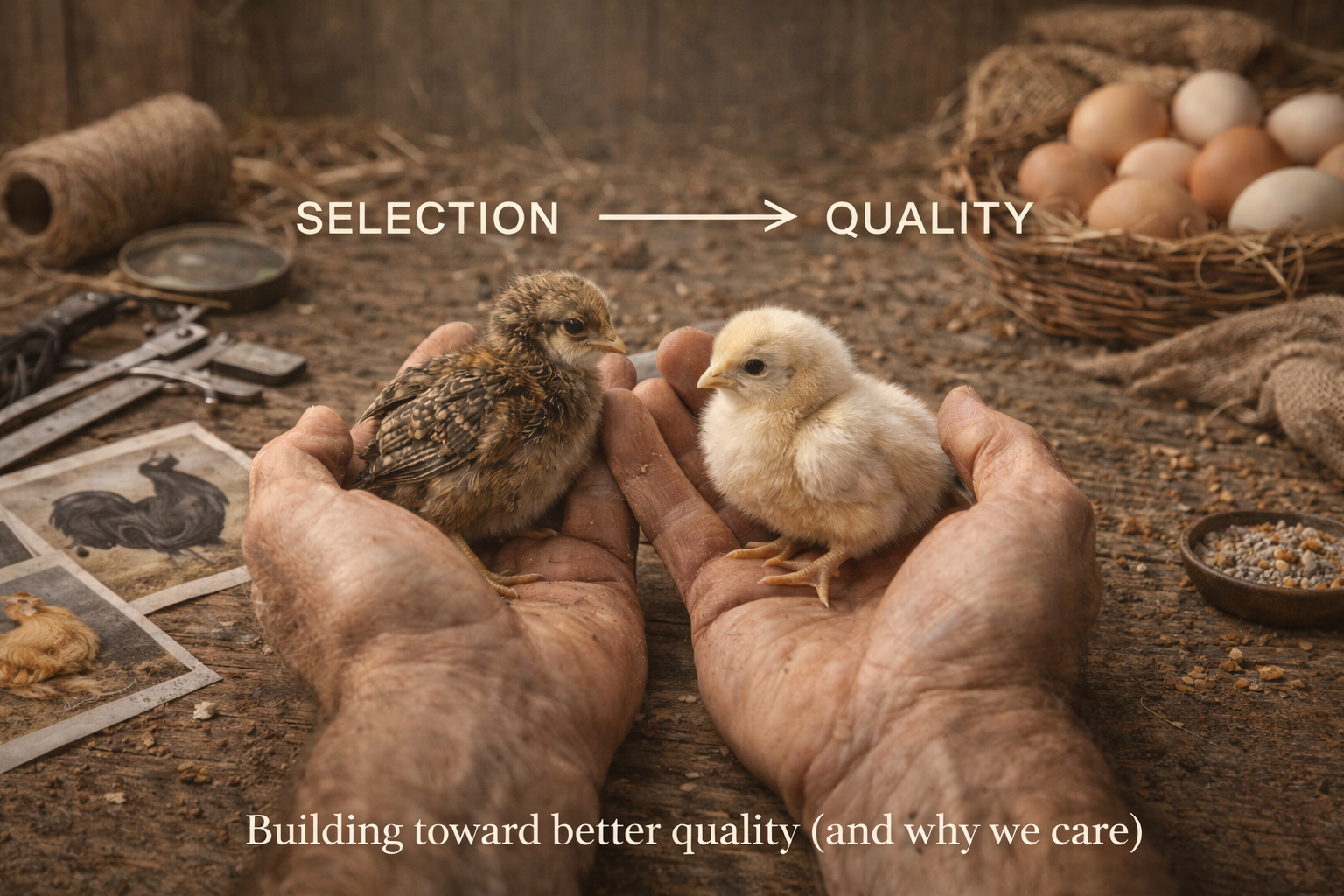
I was determined to show livestock as soon as I could, and I learned early that hard work alone doesn’t guarantee results—quality matters, and quality is built on selection. That lesson carried over into poultry quickly. My first birds that I truly thought were show quality were English Orpingtons. In late spring of 2012, we found a farm in Farmersville, Texas and brought home six BBS (Blue, Black, and Splash) Orpingtons. I raised them out with pride and did the best I knew how to do.
My first poultry show was the Collin County Livestock Show in January 2013. I didn’t even own an APA Standard of Perfection at the time, and I was learning almost everything from the judge’s table. That’s when the hard truth hit: my birds were being bred to the UK standard—not the American Standard of Perfection. I’ll be honest, it was discouraging. I had invested time, feed, care, and pride into those English Orpingtons, and at show after show I had little to show for it—not because effort was missing, but because the target was wrong. Still, those early years weren’t wasted. I met good people and started seeing what “next level” actually looks like—folks like Monty Fitzgerald, Patt Malone, and later seeing the kind of Large Fowl Brahmas that set the bar in my mind.
For a long time, I didn’t have consistent mentors. I could only attend a couple shows a year, and most of my feedback came from the judge’s table. I kept adding breeds and learning—Polish, Brahmas, Silkies—trying to understand how to build larger, more correct Large Fowl and how to make my effort show up in the birds. I bought my first APA Standard of Perfection around late 2014, and that was a major shift: I finally had something concrete to measure my birds against.
In 2015, when I was ready to pursue Light Brahmas seriously, I asked Chad Spence at the Fort Worth Stock Show poultry show if he had anything available. He’d sold out, but directed me to Benjie and Bill Bonham south of Fort Worth—people who weren’t chasing show hype, but who knew the Standard inside and out. They sold me my first two trios of truly nice Light Brahmas, and as a youth who struggled to find quality Large Fowl, I was ecstatic. Then in 2016, something got in and killed all my Orpingtons, and I decided I was done with that chapter.
The real turning point in my poultry journey—where my eye for quality truly changed—came through Timm Zitz in East Texas. The first time I stepped onto his place, I saw what I hadn’t been able to find consistently as a kid: real quality across multiple breeds and varieties—Cochins, Brahmas, Polish, and more—both standard and bantam. It wasn’t just the birds; it was the education. Around 2018, Timm helped get me started the right way with buff Brahma bantams, Large Fowl buff Cochins, Large Fowl white-crested black Polish, and even a few Large Fowl light Brahma pullets. Over multiple visits, he taught me terminology, evaluation, and what it really means to breed toward the Standard instead of guessing. It was also through those Cochins that I fell in love with the Cochin breed—massive, elegant, full of curvature and presence, and demanding enough that you have to earn quality over time.
As my circle grew, I was also fortunate to connect with breeders who helped a young exhibitor move forward the right way. Robert Anderson (Blue Hour Poultry) in Oregon sent me two trios of very nice Light Brahma bantams—birds worth building on. And on the Silkie side, Patt Dunlap and Wendy Watkiss helped shape what I know: both taught me what to look for in Silkies and how to select breeding stock with intention, not emotion. Patt taught me a lot about conditioning, and Wendy supported me over the years with very nice Partridge Silkies.
In 2019, when I moved to Ada, Oklahoma, I needed a name that matched the direction I was going. I originally had “Texas Heartland Rabbitry,” but I didn’t have an identity that covered the poultry and pigeons I was raising. That’s when Top Tier Farms became official. The name came from a simple goal: pursue quality and make quality animals—across multiple species and breeds—accessible so people can start the right way.
Our core values are simple and non-negotiable: Transparency, Integrity, and respect for the Standard of Perfection.
What We Breed Today
Today, Top Tier Farms is built around a tight, intentional group of breeds we actively work to improve.
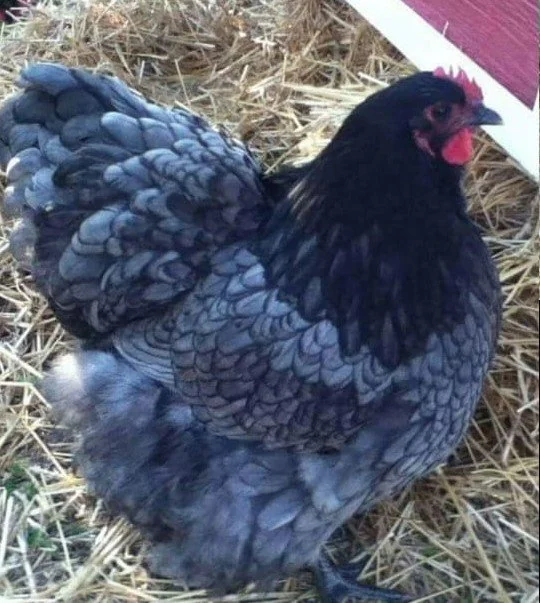
Large Fowl: Black Minorcas, White-Crested Black Polish, Buff Cochins, Black Cochins (and we’re actively working on finding White Cochins the right way).
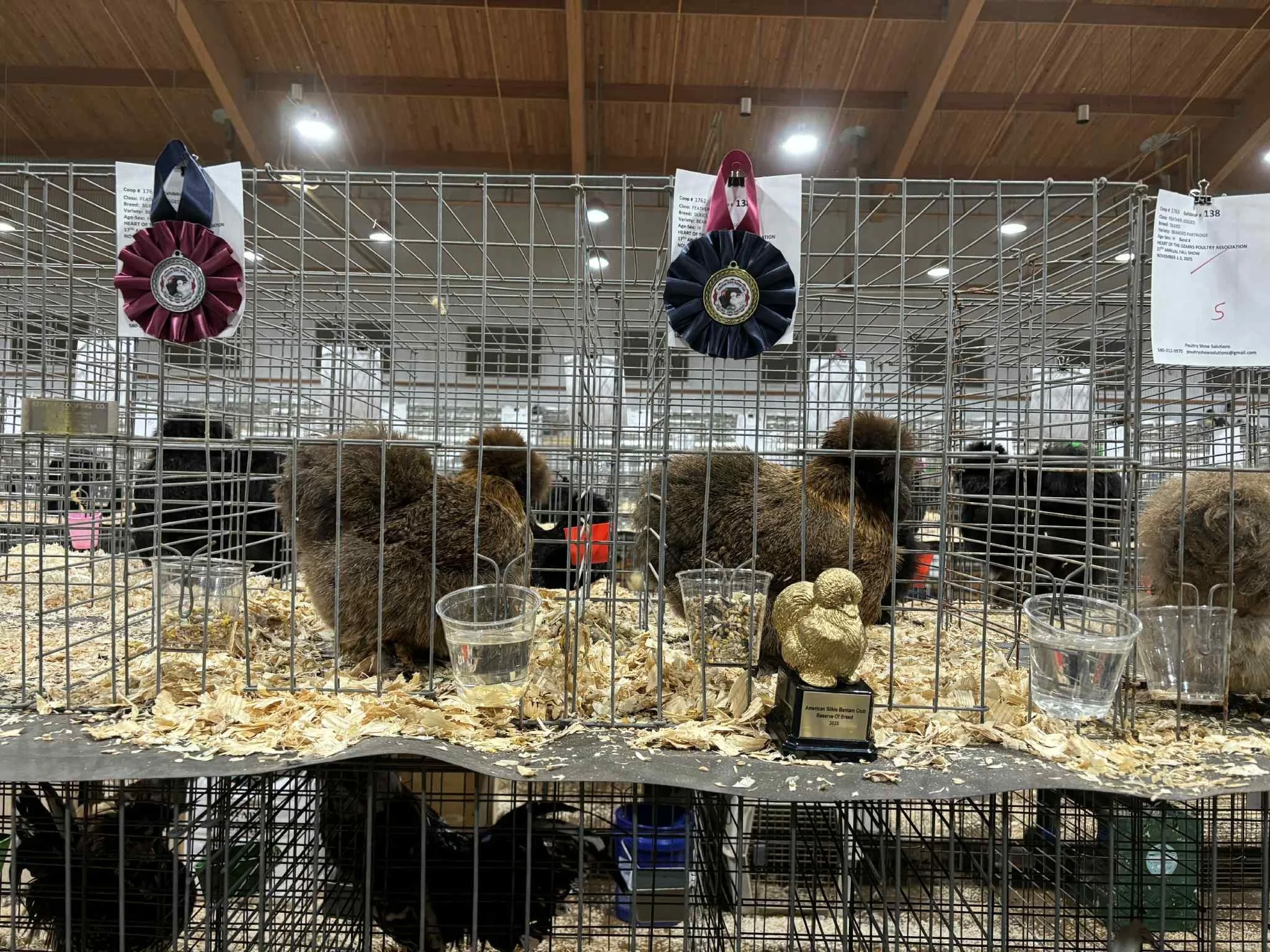
Bantams: Cochins (Black, Blue, White, Buff, Red, Partridge) and Silkies (Partridge, Black, White—bearded and non-bearded, and Self-Blue).
Some projects that were once part of my program—Light Brahmas and Tolbunt Polish—are now maintained by my grandmother at BSH Farms, and she also keeps Partridge Silkies. That allows those birds to stay in capable hands while Top Tier Farms keeps its main focus strong and improving.
What We’re Breeding For (and Why It Matters)
We keep breeds that are intricate—because they require real selection and real patience. Large Fowl Cochins are massive and elegant at the same time, and we’re committed to maintaining wide frames and width of feather while continuing to push size. In my opinion, a correct Large Fowl Cochin can’t be “too big” as long as the bird stays balanced and right.
Cochin bantams tend to be more refined, and part of our focus is improving them while keeping the correct frame and size—bantams that still look like Cochins, not tiny birds that lose breed identity.
Silkies are their own challenge: maintaining the kind of type and cushion you want while still keeping correct head points—especially a proper crest structure and consistent wing carriage. Partridge Silkies have been in our hands the longest, and we’re finally getting consistent penciling. Now the goal is to keep that pattern and type while producing a strong crop of good Partridge males.
We also added Black Minorcas for a very specific reason: I wanted a faster-developing Large Fowl breed that still has intricacy and could help reinforce mass, growth, and size, especially as we work on improving substance in Large Fowl Polish. I was fortunate to get started in Minorcas by Zack Ducan in summer 2025, and my goal is to maintain that quality while tightening up details—culling for stress bars and pushing for a bit more depth of body. Across Minorcas and Polish, we cull and select with performance in mind too: productivity, rate of gain, and size.
SOP First—But Purpose Always
We keep breeds that are intricate—because they require real selection and real patience. Large Fowl Cochins are massive and elegant at the same time, and we’re committed to maintaining wide frames and width of feather while continuing to push size. In my opinion, a correct Large Fowl Cochin can’t be “too big” as long as the bird stays balanced and right.
Cochin bantams tend to be more refined, and part of our focus is improving them while keeping the correct frame and size—bantams that still look like Cochins, not tiny birds that lose breed identity.
Silkies are their own challenge: maintaining the kind of type and cushion you want while still keeping correct head points—especially a proper crest structure and consistent wing carriage. Partridge Silkies have been in our hands the longest, and we’re finally getting consistent penciling. Now the goal is to keep that pattern and type while producing a strong crop of good Partridge males.
We also added Black Minorcas for a very specific reason: I wanted a faster-developing Large Fowl breed that still has intricacy and could help reinforce mass, growth, and size, especially as we work on improving substance in Large Fowl Polish. I was fortunate to get started in Minorcas by Zack Ducan in summer 2025, and my goal is to maintain that quality while tightening up details—culling for stress bars and pushing for a bit more depth of body. Across Minorcas and Polish, we cull and select with performance in mind too: productivity, rate of gain, and size.